Content Management

Mailbag: Take a look at WebGUI

Tavis sent an email to CMSReport.com asking me to take a look at WebGUI.  WebGUI is an open source content management system licensed under the GPL v2.

Hello, I wanted to send a quick note and see what it would take to setup a new CMS Focus category for WebGUI. The community is extremely active and there is definitely plenty of buzz about new releases, the community, and the organizations who decide to adopt it.

WebGUI also powers cmsmatrix.org...

Thanks!

Tavis 

Pardon the Mess

This Drupal site of mine has taken quite a bit of beating the past couple weeks.  While Mollom has been protecting this site well enough from the comment spammers, it isn't designed to prevent the bots from trying to ping me so much.  It has been an incredible experience to see the bots try to open every possible URL and directory here at CMSReport.com.  But probably the real stress on the site has been my testing of numerous contributed modules that are still under development.  Probably using a production server to test new modules isn't the smartest thing for anyone to do, but it does provide a nice adrenaline rush from time to time.

To make a long story short, I'm testing a number of ways I can use a Web content management system more efficiently to run this site.  I also want to do some restructuring of the site so that I have more flexibility in the look and feel of the site as well as how the content is delivered.  For the most part, I'll be using Pathauto, Views, Panels, and one of the aggregation modules.  I'm currently testing the FeedAPI module for aggregation, but none of the aggregation related modules really do what I want them to do.  I'll put up a site recipe in the next month or two on the modules I finally settle on to support this site.

Now it is time for me to go.  Evidently, one of the modules I've installed is causing some cron issues.  Am I having fun, yet?  Yes, I am.

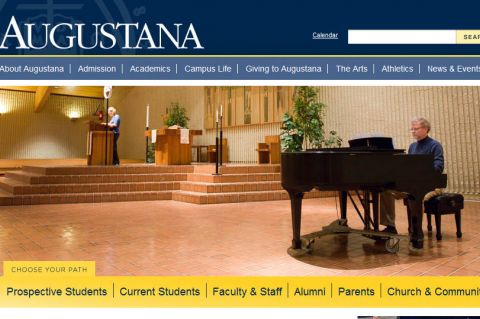
Augustana College using Drupal

Augustana College, a United States college affiliated with the Evangelical Lutheran Church in America, is using Drupal.  According to Augustana's Web Editor the site was developed by Tim Broeker of Electric Jet using Drupal 5. Electric Pulp, a local Sioux Falls company, also contributed to the project by doing the design and CSS work.

I don't think I've ever met Tim Broeker, but what is interesting about this Drupal site developer is that he also has a Joomla! Core Team connection. Yes indeed, open source does matter.

Updated Sep 8 2008 per comments at CMSReport.com

Packt Publishing announces 2008 Open CMS Award Finalists

Packt Publishing announced the five finalists for each category of its 2008 Open Source CMS Award.  Last year, Drupal was the overall winner. Voting for the winners in each of the five categories opens September 1 and ends on October 20, 2008.  This "public vote" will then be combined with votes by a panel of judges for the top three CMS in each category will then be voted for by a panel of judges.

Incidentally, this year I'll be on the panel of judges for the Most Promising Open Source CMS.

Overall Open Source CMS Award

Review: Bitrix Site Manager

Bitrix Site Manager may seem unassuming, but underneath this CMS lays a fantastic algorithm that drives this CMS' performance over almost all other existing CMS applications out there. It's most definitely the most cost effective Content Management system today.

Introduction:

Having worked extensively with open source CMS applications like Joomla, Mambo and Drupal, we've come to realize one universal fact. Microsoft does not like them. Ergo - Internet Explorer does not like them. Which eventually means that a majority of browser users find it difficult to work with user controlled content over the web, if the CMS installed happens to be a Joomla or a Drupal.

Newton: How Web 2.0 will change the face of business

John Newton, Alfresco, posted a well written article on the business changes Web 2.0 will continue to the enterprise.  I not only liked what he had to say about the strength of social publishing tools for knowledge sharing within a company, but also Web 2.0's strength to blend required knowledge available both inside and outside the organization.

DokuWiki

Linux.com has a review of DocuWiki.  I've used/seen DocuWiki in the past, but for some reason or another I've never mentioned it here at CMS Report.  DocuWiki runs on a flat file system (no database required) and I've known people to choose it over others due to its easy to use ACL (access control list).

Geeklog 1.5.0 Released

After 18 months of development, Geeklog 1.5.0 has been released.  As I mentioned last month, changes found in Geeklog 1.5.0 incorporates the following projects implemented during the 2007 Google Summer of Code:

  • New user-friendly install script
  • New Configuration Graphical User Interface
  • New Webservices API based on the Atom Publishing Protocol

Additional new features and enhancements included in this release:

Sacha Chua on Enterprise 2.0, Drupal, and the Head Shot

Partial Screenshot from Sacha's SiteSeth Gottlieb, Content Here, recently turned me on to Sacha Chua and her blog.  Sacha is an Enterprise 2.0 consultant and application developer for IBM and she also happens to be a very good blogger.  What makes her blog interesting, besides being well written, is her posts on corporate use of social technologies given from the perspective of her generation, the Millennials (latest hip word for Generation Y).

While some organizations are still debating about introducing Web 2.0 technologies to their employees, this newest generation now entering the workforce is likely to expect that such technologies are already available to them for use in their daily work tasks.  While the use of information technology is often viewed by companies in terms of staying competitive and a requirement for implementing strategic plans, the technologies are also increasingly becoming an essential tool for the human resources department.  If you're expecting to attract and keep bright educated Millennials such as Sacha within your organization, you then need to better understand how people in her work cohort are likely to process the work given.